How to Move to Norway
A practical guide in 4 steps — from first dream to first neighbour
Moving to a Norwegian village is a journey that unfolds in stages — each one bringing you closer to a life you might never have imagined.
This guide walks you through the four essential steps: finding the right place, securing work, preparing for daily life, and finally settling into your new community. Whether you're still dreaming or already packing, here's how to make it happen.
Find Your Place
Before the paperwork and the packing, there's a quieter question: where will you go? Norway is full of places that aren't on the tourist trail — villages where life is shaped by the landscape, the seasons, and a community that still knows each other by name.
Start with a Visa
Before you decide where, you need to know if you can. If you need a visa, apply well in advance. Start with the Norwegian Directorate of Immigration (UDI) to learn exactly which permits apply to your situation.
If you're a Nordic or EU/EEA citizen, your path is simpler — check our immigration rules guide for specifics.
Choosing a Location
Norway's geography is staggeringly varied. You might be drawn to a fjord village where mountains meet the sea, a highland community surrounded by open plateaus, or a coastal town where fishing boats line the harbour.
Think about what matters most to you: proximity to nature, access to schools, distance to a city, the kind of work available, and the community's character. Every Norwegian village has a different rhythm.
Use our village finder to explore communities across Norway. Each village profile includes information about location, landscape, community, and what makes life there special.
Many people visit their chosen village before committing — it's easier to feel whether a place is right when you walk its roads, meet its people, and see the light change over its mountains.
Finding Housing
Housing in Norwegian villages is typically much more affordable than in cities. Some municipalities actively recruit new residents and may offer incentives — discounted building plots, renovation grants, or help connecting you with available properties.
The main housing platforms in Norway are Finn.no for purchases and rentals, and many municipalities list available properties on their own websites. Local Facebook groups are often the best source for rentals in smaller communities.
Many Norwegian villages have established welcome programmes for newcomers. Contact the local municipality (kommune) directly — they are often genuinely eager to help new residents settle in, and can connect you with housing, local employers, and integration programmes.
Find a Job
Work is often the anchor that makes relocation possible. The Norwegian job market values competence and initiative — and many rural communities are actively searching for skilled workers, from healthcare professionals to carpenters, teachers to tech workers.
Get Your Education Approved
For most skilled positions, you'll need to have your foreign qualifications recognised in Norway. NOKUT (Norwegian Agency for Quality Assurance in Education) handles general recognition of foreign higher education and vocational training.
Some professions — like healthcare, teaching, and law — require additional authorisation from sector-specific bodies. Start this process early, as it can take several months.
Where to Look
Norway's job market operates through several channels. Arbeidsplassen (NAV) is the public employment service with thousands of listings. Finn.no is the largest private job portal.
For rural areas specifically, contacting the municipality directly can be highly effective. Many villages have jobs that never reach the major platforms — in schools, nursing homes, municipal services, and local businesses.

The Norwegian CV
Norwegian CVs tend to be concise and factual — typically 1–2 pages. Include personal details, education, work experience, language skills, and references. A photo is optional but common.
Cover letters (søknad) matter more than in many countries. They should be tailored to each position and demonstrate why you want to work in that specific community, not just that specific job.
Interviews in Norway
Norwegian interviews are typically informal and egalitarian. First names are standard, and the atmosphere is conversational rather than interrogative. Employers value honesty, competence, and the ability to work independently.
Be prepared to discuss how you would contribute to the team and the community. In a small village, your employer may also be your neighbour — cultural fit matters as much as professional skill.
- NAV Arbeidsplassen — public job listings
- Finn.no Jobb — Norway's largest job portal
- NOKUT — education recognition
- LinkedIn — growing in Norwegian market
- Local municipality websites — unlisted rural positions
- EURES — EU/EEA job mobility portal
Prepare for Daily Life
You've found your village and secured work. Now it's time to prepare for the practical realities of Norwegian life — from schools and language to weather and taxes. This step is about building the foundation for a life that works.
Learn the Language
While many Norwegians speak excellent English, learning Norwegian transforms your experience. It opens doors to friendships, community life, and understanding the culture from the inside. Most municipalities offer free or subsidised Norwegian language courses for newcomers.
Norwegian has two written forms — Bokmål and Nynorsk — and every region has its own dialect. Don't worry about perfection. Norwegians deeply appreciate the effort, and most will be patient and encouraging.
Schools and Childcare
Norwegian public schools are free and generally excellent. Children have the right to education from age 6, and most villages have their own primary school. The school system is egalitarian — no uniforms, first-name basis with teachers, and a strong emphasis on outdoor activity and social learning.
Barnehage (kindergarten) is available from age 1 and heavily subsidised. Contact your municipality early to secure a place, as availability varies by village.

Weather and Clothing
There's a Norwegian saying: "There's no bad weather, only bad clothing." This isn't a cliché — it's a survival strategy. Invest in proper outdoor gear: waterproof layers, wool base layers, and sturdy boots are essentials.
Winters are long and dark in many villages, but also magical. The northern lights, the first snow, koselig (cosy) evenings by candlelight — Norwegians don't just endure winter, they embrace it.
Culture and Social Life
Norwegian social culture can feel reserved at first. People tend to be polite but private — don't expect small talk with strangers. But once you're in, you're in. Joining local activities — sports clubs, hiking groups, volunteer organisations — is the fastest way to build genuine connections.
Respect for nature, equality, and personal space are deeply embedded values. Understanding these helps you navigate social situations and build trust with your new neighbours.
Taxes and Social Services
Norway has high taxes, but they fund world-class public services: free healthcare, education, generous parental leave (49 weeks at full pay or 59 weeks at 80%), and a strong social safety net. As a resident, you'll be enrolled in the National Insurance Scheme (Folketrygden), which covers healthcare, pensions, and unemployment benefits.
You'll receive a tax card (skattekort) when you register, and your employer handles tax deductions. Most people find the system straightforward once set up.
Pre-Departure Checklist
- Valid passport and visa/residence permit (if required)
- Education recognition from NOKUT (if applicable)
- Employment contract or acceptance letter
- Housing arranged — at least temporary accommodation
- Health insurance for the transition period
- School/kindergarten registration for children
- Basic Norwegian language course started
- Winter clothing and outdoor gear
- Important documents translated to English/Norwegian
- Notify authorities in your home country of relocation
Bringing Pets
Norway has strict import regulations for animals. Dogs and cats must be microchipped, vaccinated against rabies, and treated for tapeworm (dogs only) within specific timeframes before arrival. You'll need a pet passport or veterinary certificate depending on your country of origin.
Check the Norwegian Food Safety Authority (Mattilsynet) for current requirements — rules are enforced and penalties are serious.
Settle In
You've arrived. The boxes are unpacked, the keys are in your hand, and the mountains outside your window are real. Now begins the most rewarding step — becoming part of a community that's been waiting for you.
Join Your Community
Village life in Norway is built on participation. The fastest way to feel at home is to show up — at the local store, the school events, the hiking trail, the volunteer work day. People notice effort, and they respond to it.
Many villages have established integration programmes, welcome events, and buddy systems for newcomers. Contact your local municipality or volunteer centre (frivilligsentral) to learn what's available.

Dugnad — The Norwegian Way
Dugnad is a uniquely Scandinavian concept — voluntary community work where everyone pitches in. It might be painting the local hall, clearing trails, or preparing for a festival. Showing up for dugnad is one of the most powerful ways to earn trust and build friendships.
It's not just about the work — it's about the coffee breaks, the conversations, and the shared sense that this place belongs to everyone who takes care of it.
Embrace Friluftsliv
Friluftsliv — the "free air life" — is central to Norwegian identity. Norway's allemannsrett (right to roam) gives everyone access to uncultivated land, rivers, and coastline. Walk, ski, fish, forage, swim — the landscape is yours to explore.
In a village, nature isn't an escape from daily life; it is daily life. Children play outside in all weather, neighbours meet on the trail, and the seasons set the rhythm of community events.
Building Your New Life
There will be moments of homesickness and moments of wonder. The first time you see the northern lights from your garden. The first time a neighbour drops off fresh-baked bread. The first time you realise you just had a conversation entirely in Norwegian.
Life in a Norwegian village isn't always easy, but for those who embrace it, it offers something increasingly rare: a sense of belonging, a connection to nature, and a community that genuinely cares whether you stay.
Curious which Norwegian village could be your best match?
Freysta matches you with villages based on what you’re looking for — jobs, lifestyle, and community.
- Real job openings linked to villages
- Matched to your preferences
- Direct dialogue with villages
Completely free — and always will be.
Freysta Portal for Members
Your next career move starts with a place
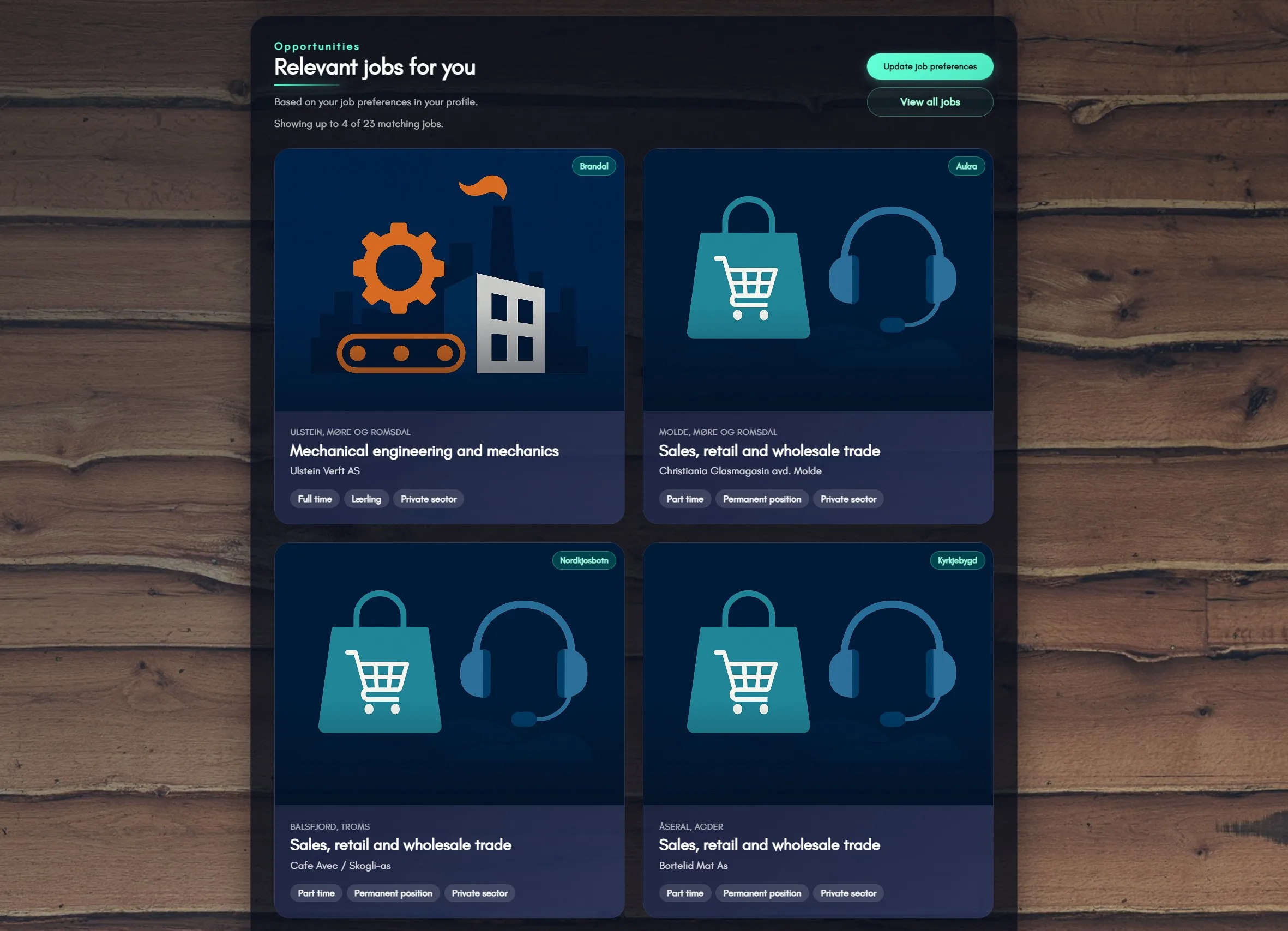
Freysta shows real job openings from across Norway — each one linked to a specific village. Explore a position and get to know the place around it, all in one view.
People are different — and Norwegian villages are too.
Describe what matters to you — nature, services, activities — and Freysta shows you villages that fit. Not a score. A starting point.
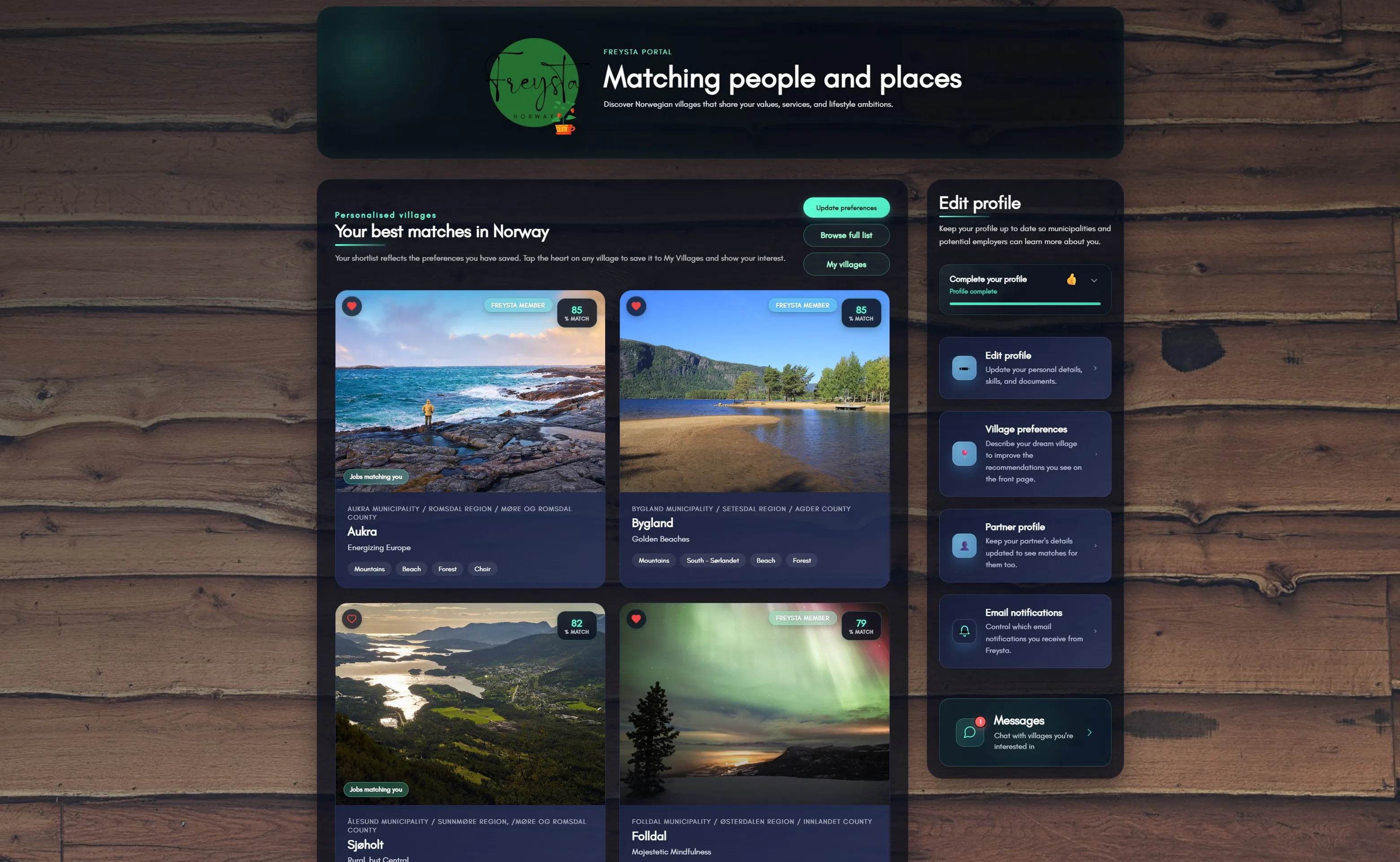
Start a conversation — when it makes sense
Freysta makes it easy to start a direct conversation with participating villages on the platform. Message village representatives, ask questions, and share documents — all in one place. In some cases, villages may also reach out to you if they think you could be a good match.
Dialogue happens when there’s mutual interest — on your terms.
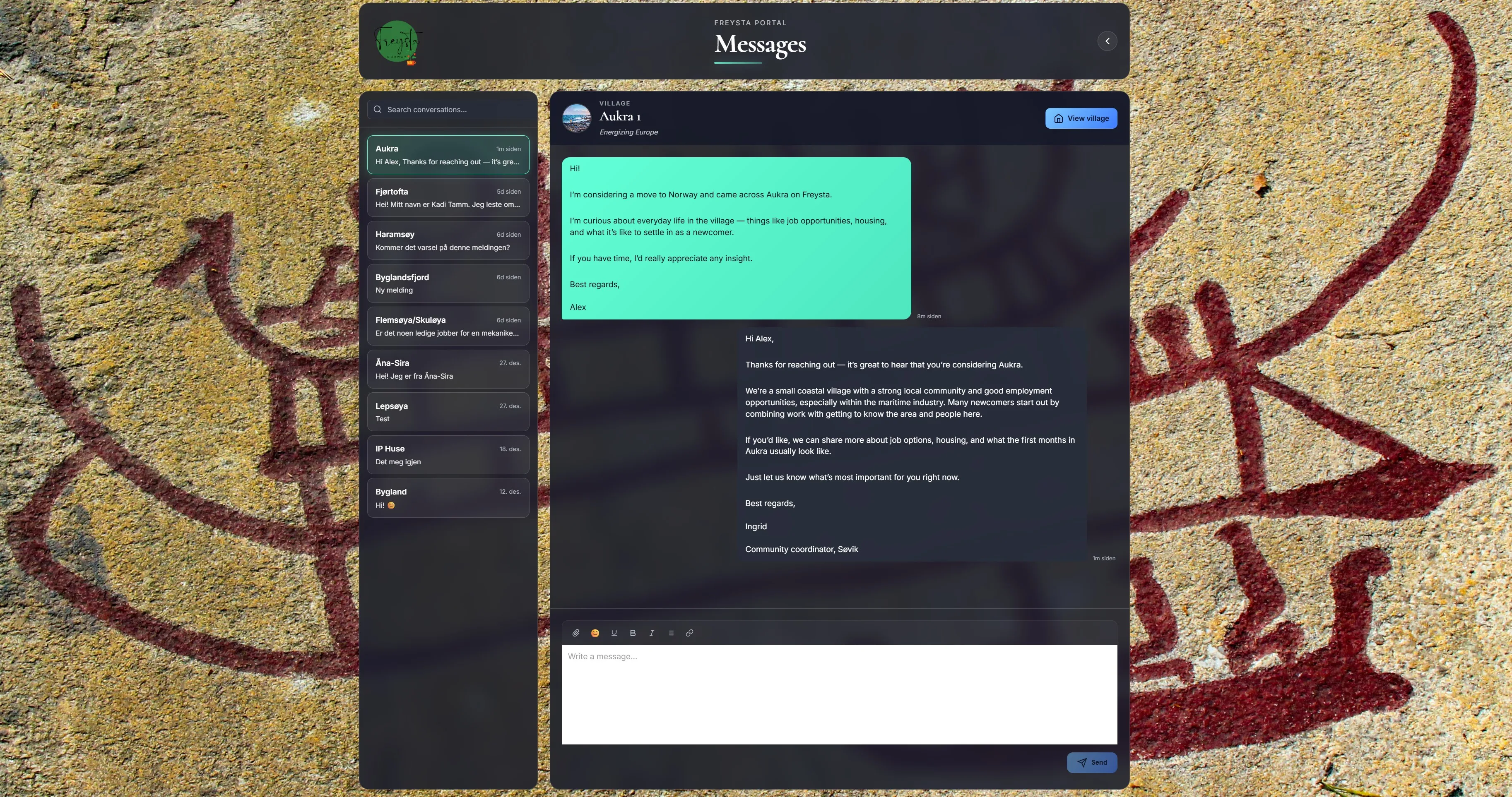
What happens after you sign up?
You set up a profile — in minutes
You choose what matters to you in a place to live, along with your background and job interests. You can add more details later if you want.
You see villages and jobs that match you
Explore Norwegian villages that fit your preferences, with live updates on job openings in rural areas that match your skills.
Villages and employers may reach out
Village representatives and local employers can view your profile and contact you if they think there’s a good match.
You can get job alerts if you want
Receive notifications when new jobs are posted in villages you’re interested in — or turn alerts off at any time.
You can start conversations when it feels right
If you want to, you can also contact villages directly through the platform.
Simple, human matchmaking — always free for people who want to move to a Norwegian village.